
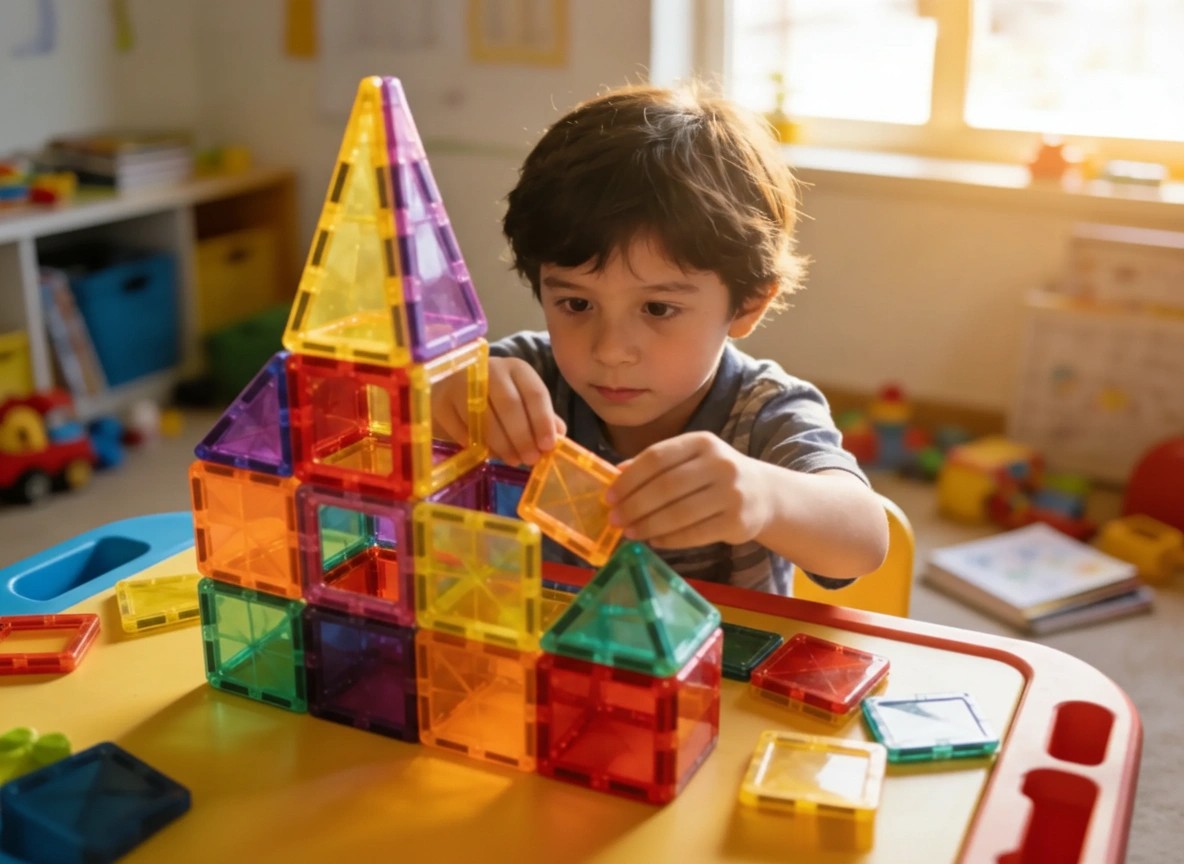
As a parent and educator, I'm often asked about the "best" educational toys for young children. While there's no single perfect answer, magnetic building tiles consistently rank at the top of my recommendations—and for good reason. These colorful, seemingly simple toys pack a powerful educational punch that extends far beyond basic play.
Research in early childhood development shows that hands-on construction play significantly impacts cognitive development, particularly in STEM areas (Science, Technology, Engineering, and Mathematics). Magnetic tiles offer a unique combination of immediate gratification and complex learning opportunities that keep children engaged for years.
1. Spatial Reasoning and Geometry
Spatial reasoning—the ability to visualize and manipulate objects in three-dimensional space—is a foundational skill for mathematics and engineering. When children build with magnetic tiles, they're constantly exercising this mental muscle.
How It Works:
Unlike traditional blocks that simply stack, magnetic tiles allow children to build in multiple directions simultaneously. A four-year-old might start with a flat square on the floor, then add triangular pieces vertically to create walls. Suddenly, they've transformed a 2D shape into a 3D structure—a concept that typically isn't formally taught until elementary school geometry.
Through repeated play, children develop an intuitive understanding of:
- How shapes fit together and connect
- The relationship between 2D faces and 3D structures
- Symmetry and pattern recognition
- Angles and how they affect structural stability
2. Engineering Principles Through Trial and Error
Every time a magnetic tile tower collapses, your child is learning engineering principles. This might sound counterintuitive, but failure is one of the most valuable aspects of construction play.
The Engineering Design Process:
Watch a child build with magnetic tiles and you'll observe them naturally following the engineering design process:
- Imagine: "I want to build a tall castle"
- Plan: Selecting which pieces to use
- Create: Building the structure
- Test: Does it stand up?
- Improve: Rebuilding with modifications when it falls
This cyclical process of testing and refining builds resilience and problem-solving skills. Children learn that failure isn't final—it's information. The magnetic connection provides instant feedback: either the structure holds or it doesn't, prompting immediate reflection and adjustment.
3. Understanding Magnetism and Physics
Magnetic tiles introduce fundamental physics concepts in a tangible, age-appropriate way. Even toddlers can observe cause and effect: bring two tiles together and they click satisfyingly into place. Pull them apart and they resist, then separate.
Scientific Concepts Children Discover:
Magnetic Attraction and Repulsion: Children quickly learn that magnets have different "sides." Sometimes pieces snap together easily; other times they push apart. This hands-on experience with magnetic poles is far more memorable than any explanation.
Gravity and Balance: Building tall structures requires understanding center of gravity, even if children can't articulate it. Through experience, they learn that a wide base supports a tall tower better than a narrow one.
Strength and Structure: Triangular structures are stronger than squares. Children discover this empirically: their triangular pyramid stands firm while their tall rectangular tower topples.
4. Pattern Recognition and Mathematical Thinking
Mathematics is fundamentally about identifying and creating patterns. Magnetic tiles offer endless opportunities for pattern work at various complexity levels.
Age-Appropriate Pattern Activities:
Ages 3-4: Simple color patterns (red-blue-red-blue) or shape patterns (square-triangle-square-triangle)
Ages 5-6: More complex sequences and symmetrical designs, beginning to count pieces and compare quantities
Ages 7+: Creating repeating geometric patterns, calculating perimeters, and understanding fractional relationships between shapes
Children also develop one-to-one correspondence (counting each piece individually), number sense (estimating how many pieces they'll need), and basic addition and subtraction (combining sets of pieces or dividing them for different projects).
5. Executive Function and Planning Skills
Building complex structures with magnetic tiles requires planning, focus, and the ability to hold a mental image while working—all components of executive function, the cognitive skills that enable us to plan, focus attention, and juggle multiple tasks.
Cognitive Skills in Action:
Working Memory: Keeping the intended design in mind while selecting and placing pieces
Impulse Control: Carefully placing tiles rather than randomly sticking them together
Flexible Thinking: Adapting the plan when pieces don't fit as expected or when the structure needs modification
Task Initiation and Completion: Starting a project and persisting until it's finished, even when challenges arise
These executive function skills transfer directly to academic success. Children who can plan, focus, and persist through challenges perform better in school across all subjects.
Making the Most of Magnetic Tile Play
To maximize the educational value of magnetic tiles:
- Follow Their Lead: Let children direct their own play rather than insisting they follow instructions. Self-directed play produces deeper learning.
- Provide Adequate Time: Complex building takes time. Rushed play sessions limit what children can accomplish and learn.
- Ask Open-Ended Questions: "What would happen if...?" or "How could you make it taller?" encourages thinking without directing the outcome.
- Display and Photograph: Treating their creations as valuable builds confidence and encourages more ambitious projects.
- Play Together: Collaborative building teaches cooperation while modeling problem-solving strategies.
The Long-Term Impact
The benefits of magnetic tile play extend well beyond early childhood. The spatial reasoning skills developed through construction play correlate with success in STEM fields later in life. Engineering, architecture, surgery, and computer programming all require strong spatial abilities.
Perhaps more importantly, magnetic tiles teach children that learning can be joyful. When education feels like play, children develop positive associations with challenge and discovery that serve them throughout their lives.
As both an educator and a parent, I've watched magnetic tiles captivate children from their first birthday through middle school. The open-ended nature means the toy grows with the child—simple stacking for toddlers evolves into complex architectural designs for older children.
The best educational toys aren't the ones with flashing lights and preset learning programs. They're the ones that step back and let children's natural curiosity and creativity lead the way. Magnetic tiles do exactly that, making them a worthwhile investment in your child's development.
Ready to Start Building?
Explore our collection of safety-certified magnetic tiles and building sets designed for every age and skill level.
Shop Magnetic Tiles